Danube Key to Ukraine’s Trade and Economic Recovery, Driving Regional Growth Potential
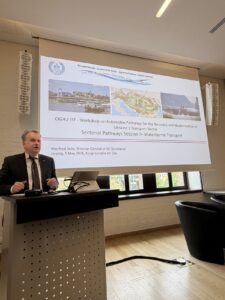
The Director-General of the DC Secretariat attended the Annual Summit of the International Transport Forum (ITF) at its 20th anniversary. In the margins of the Summit he partipated in a workshop on Actionable Pathways for the Recovery and Modernisation of Ukraine’s Transport Sector, focused on providing support for Ukraine’s immediate transport-related material needs, as well as analytical support for the longer-term rebuilding of Ukraine’s transport links. The meeting addressed the coordination of urgent recovery needs, including priorities for waterborne, surface, aviation and transport pathways.
In his intervention, the Director-General presented the DC activities in the framework of the Danube Solidarity Lane and the publication of the Register of Damage in the Lower Danube Region caused by Russian Military Actions. In the current security context, Danube and its ports have proved to be key for UA exports and imports and will also be essential for the recovery of the UA economy, offering great economic potential for regional development.
The representative of the DC presented several perspectives aimed at creating an integrated, sustainable, and strategically important economic corridor on the Danube. A Lower Danube Cross-border Economic Development Zone (LD-CBEDZ) involving 3 countries (UA,RO, MD) and 13 port locations could help transform the region into a structured, EU-anchored growth corridor serving as a vehicle for Ukraine’s post-war economic reconstruction, a catalyst for Moldova’s EU pre-accession convergence; and an instrument for regional development.
Building on the important progress and results of the current Danube Solidarity Lane, this could be developed into “Europe’s first fully digitalised transport corridor for seamless cross-border traffic EU-UA/MD”, as central element of a dedicated cross-border development strategy for the lower Danube region.